Market climateLive
Mr. Market climate
Read the weather
Eight gauges — valuation, spreads, breadth and volatility — distilled into one read: is the market demanding, or forgiving?
First, the scale nobody pictures correctly: what the same $100 became from 1965, asset by asset, on an unbroken axis.
Fat Pitches turns the Buffett–Munger philosophy into a working app: the same process, on top of your own broker. Know the boundaries of your circle of competece. Avoid risk, be selective. Demand a Margin of Safety on the price. And when the Fat Pitch comes, swing big.
At these rates the gap to the index doubles every 8 years. The cost of waiting is not linear.
Estimated annualized returns in USD, 1965–2026: Berkshire Hathaway 19.8% · S&P 500 total return 10.4% · IBEX 35 total return ≈ 8.4% · US housing with rent ≈ 8.5% · Spanish housing with net rent ≈ 6%, price only ≈ 3.9%. The 10% scenario is hypothetical: +0.9 pp per year over the index for 61 years. Illustrative, not a promise. Past performance does not guarantee future results.
News, volume, and price moves are designed to capture attention. Research shows retail investors are more likely to buy the stocks that capture it. But attention is not evidence. A price move is not a thesis, and an alert is not a reason to act. FatPitches helps you define the business, the value, and the price before the market asks for a reaction.
Three gates stand between a company and a hole on your card.
Is this a business you understand well enough to tell when its story stops being true? Know the boundaries of your circle.
Knowing the risk, can you picture the business long term? You better don't compensate for that. Rule #2
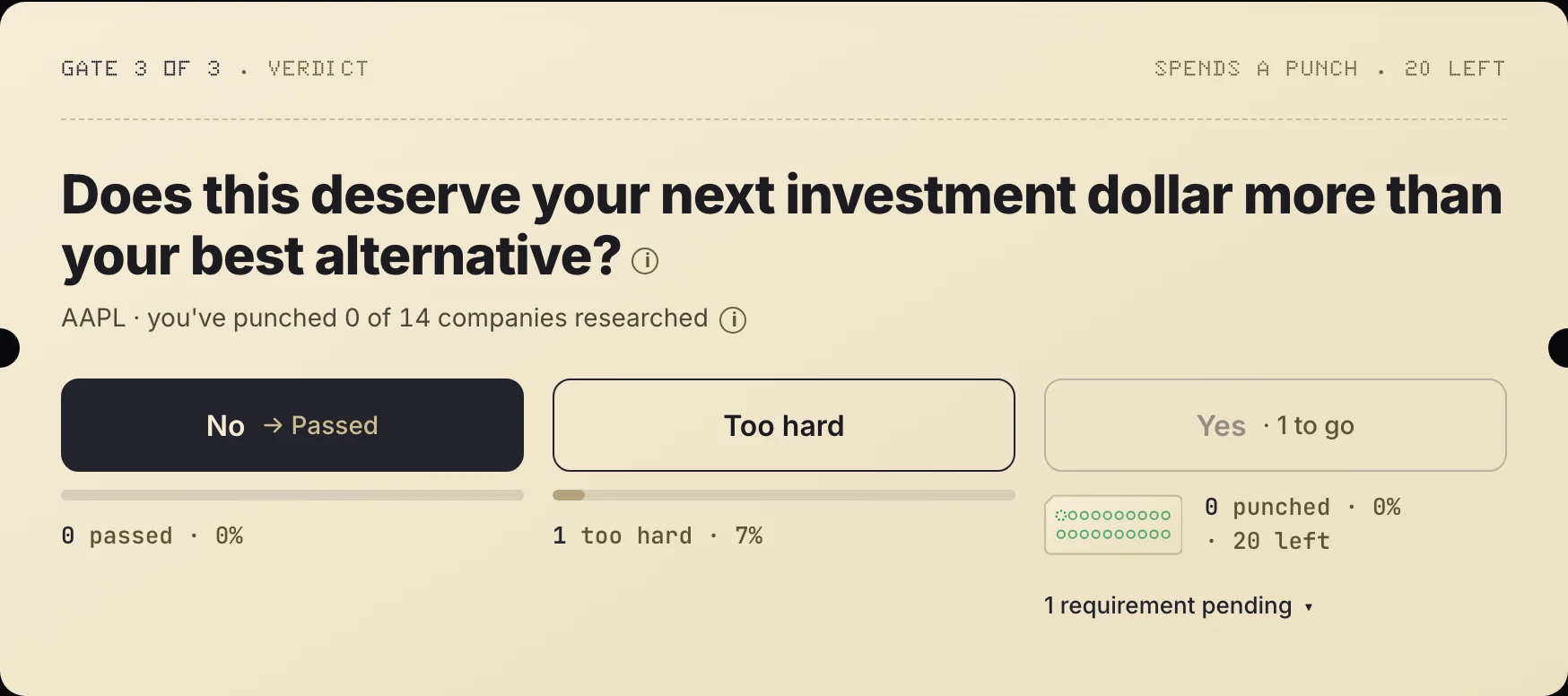
Is this business your best alternative? Decide where it belongs among the three piles for investing: too hard, no or yes.
I ask the questions your thesis hopes you won’t ask. And I constantly recall you rule #1
Years of 10-Ks, 10-Qs, 8-Ks and earnings calls, read and scored for concern, with the elevated flags named rather than buried. Search every quarter at once — and see which analyst questions management did not answer.
I build the bear case — what could kill this business, and what the market might be missing.
A quality-minus-junk score grades profitability, safety and earnings integrity against sector peers. Then the same decade is replayed as what you pay against what you get — so cheap and cheap-for-a-reason stop looking alike.
Insider ownership, buyback timing and what the chief executive is actually paid to hit, read straight from the latest proxy. Then every Form 4 filed, and which of 13 investors worth following already hold it.
Three stressed floors — earnings power, book value, recoverable — put a number on permanent loss, and the 52-week low and 200-day sit apart from them as price references, not estimates of worth. A three-scenario discounted cash flow then prices the business, and a reverse DCF reads back what the market is already assuming.
Drag the entry and the intrinsic value, and the margin of safety moves with them — 47% at $227, and how far the quote still has to travel to get there. Analyst targets and 17 years of valuation history sit underneath as context, not instruction.
A weighted scorecard you answer yourself, question by question. Facts are supplied to judge from — never a verdict — and every thesis you write is argued against a steelmanned bear. No order clears without one.
I challenge your thesis against the consensus before you score your confidence.
Textbook position sizing divides by variance — the more a price wobbles, the smaller the bet. That makes price movement the definition of risk, which is the opposite of what every value investor says they believe.
Ours never mentions volatility. It sizes off how far the stock can fall to a balance-sheet floor, then caps that against your own risk budget. Two ceilings, and the tighter one wins.
weight = min( Kelly ceiling , risk budget ÷ downside to floor )
Type the price you would pay. It's sized against a cached balance-sheet floor and the risk budget you pick. Nothing is stored, and no market quote is published.
The hard part isn’t the math — it’s behavior. Color and framing are tuned to cool you down, not light you up; no order clears without a written conviction; and the thesis is yours, argued against a steelmanned bear — never the consensus AI take.
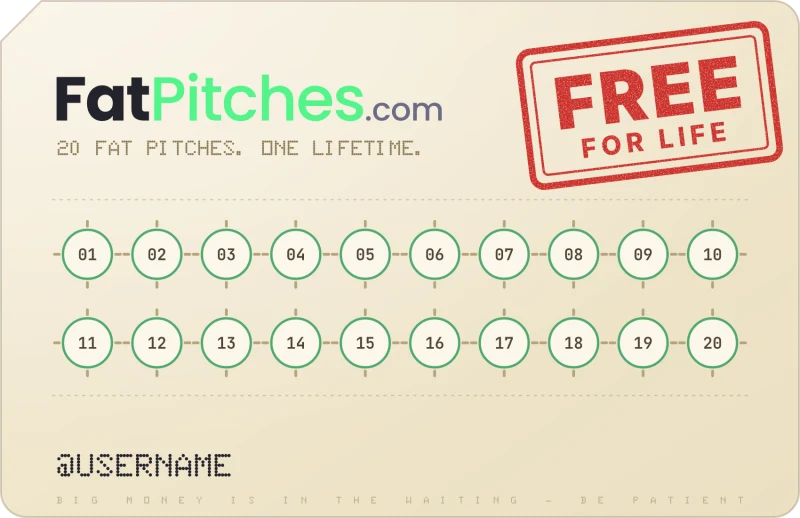
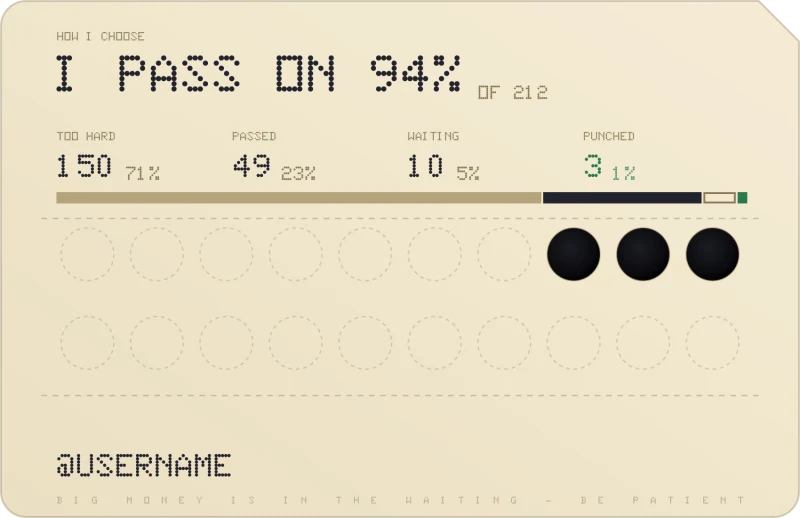
Your membership card, with twenty holes. Paying members also carry a Member №. Buffett said most investors would do better with a card that allowed twenty punches in a lifetime — one per investment decision, no refills. Research is not what gets punched: read as much as your plan allows. A hole is punched when a company you are waiting on finally trades at your price — a fat pitch. Twenty holes, one lifetime, the same card on every plan. Patience is what fills it.
Full research on 10 stocks, for life, with nothing held back on any of them: the full analysis suite, the quality screener, the conviction journal, the virtual portfolio, and Ben ✧ AI drafting your journal answers from the company's own filings. It is a product, not a trial. There is no countdown and no expiry date, and we have committed publicly to keeping it that way. The position-size calculator doesn't count toward your 10 — it needs no account at all.
Not for the free plan. No card, no billing details, nothing to cancel. A card only comes up if you choose Essential after working through your 10.
FatPitches is the value investor’s platform. A place to understand a business, challenge your investment thesis, set the price you would pay, and wait. Most investing software wants you to watch more, screen more, react faster, and trade more often. The old agency problem. FatPitches is built for the opposite.
FatPitches is for investors who want to own understandable businesses for years, not rent ticker symbols for days. For people who care more about cash flow than commentary. For people who would rather pass on ten plausible ideas than force one mediocre decision. For people who want a toolkit, not a casino.
No. FatPitches does not replace your judgment. It asks more of it. It helps you make your assumptions visible: what must remain true about the business, what price makes the investment attractive, what could invalidate the thesis, and how much capital the opportunity deserves. A tool that tells you what to buy teaches dependence. A tool that helps you think clearly gives you a process you can keep.
Ben ✧ AI isn't here to tell you what to buy, or why. It is here to show you what the market appears to believe—and to ask whether you have earned the right to disagree. FatPitches uses AI to map the consensus, expose assumptions, surface counterarguments, and pressure-test your thesis. The machine can bring the questions. Only you can own the answer.
Most investors do not need more reasons to like an idea. They need a better way to find the reasons they might be wrong. FatPitches helps separate what you know from what you assume, a good business from a good purchase, a temporary price fall from a broken business, confidence from evidence, and a story from an investment case. Your thesis should not be protected from criticism. It should be improved by it—or abandoned when the facts demand it.
Because a ticker is not an investment. It is a symbol attached to a fractional claim on a real business: its customers, margins, cash flows, debt, management, competitive advantages, and ability to reinvest capital. The market quotes a price every second. The business changes much more slowly. FatPitches is designed to keep your attention on the thing you are actually buying.
Because waiting is part of the work. A wonderful business can still be a poor investment at the wrong price. And a falling share price is not automatically an opportunity. The discipline is simple and difficult: understand the business, decide what it is worth, set the price you would be happy to pay, keep your cash available, and wait. Doing nothing is not the absence of a strategy. Doing nothing can be the strategy.
A fat pitch is not simply a stock that fell. It is an ownership opportunity where several things line up: the business is understandable, the economics are attractive, the risks are visible and acceptable, the thesis can withstand scrutiny, the price offers enough margin for error, and the opportunity is good enough to deserve scarce capital. Most companies will not qualify. That is the point. Enjoy Buffett's masterclass.
No. If you want more signals, faster entries, momentum setups, technical indicators, or reasons to trade today, FatPitches is probably not for you. It is for investors willing to let opportunities go by, hold cash without guilt, and act only when business quality and price finally align.
Because being right is not enough. An investor also has to decide how much of their capital belongs behind an idea. A small position in a truly exceptional opportunity and an oversized position in a fragile thesis are both allocation mistakes. FatPitches treats sizing as a consequence of knowability, downside, price, and conviction—not simply volatility. Your capital is a bucket. The question is not only whether a business is attractive. It is whether this is the best use of the water still in the bucket.
Then FatPitches is working. A tool that always gives you something to buy is not a tool for disciplined investing. It is a machine for turning attention into activity. There will be periods when excellent businesses are expensive. There will be periods when you do not know enough. There will be periods when the right answer is to study, wait, or pass. Cash is not a failure to invest. Cash is the ability to invest when the right opportunity finally appears.
Only if you use it to become harder to fool. Not harder for the market to fool. Harder for you to fool. FatPitches can make assumptions visible. It can make price discipline explicit. It can make a thesis easier to revisit. It can show when the facts no longer support the story. But it cannot do the most important part for you: it cannot make you wait.
No. FatPitches is a research and decision-support tool. It helps you structure your thinking, examine a business, document an investment thesis, and define your standards. It does not know your complete financial situation, objectives, tax circumstances, liquidity needs, or tolerance for loss. You remain responsible for every investment decision.
Privacy is one of FatPitches's core values. We use the minimum data required to run the service. Your invoicing details never even reach our servers — we partner with Paddle, our merchant of record, which takes good care of them. We don't sell your data, and we never will. Period.
Free research on 10 stocks — every feature, forever. No credit card. No password. Your thesis, your decisions.