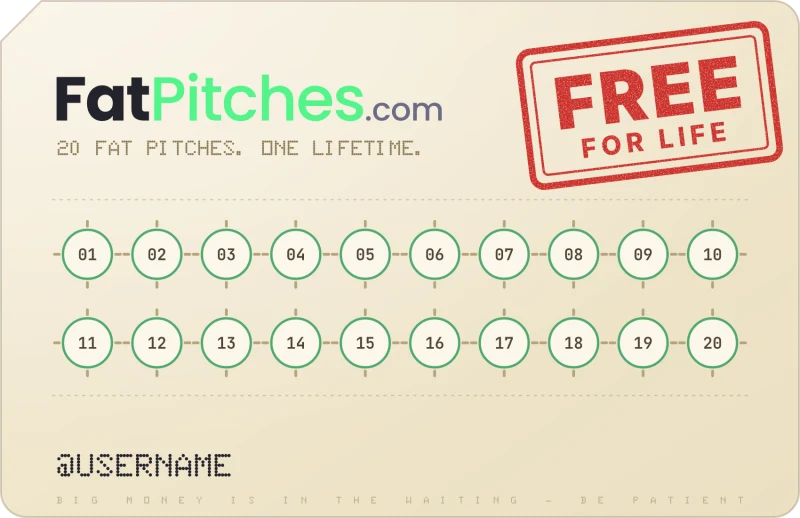
Twenty slots on a card. Every investment you make punches one, and when the card is full you can’t invest again for the rest of your life. Would the stock you’re looking at today get a punch?
Buffett used the idea when he lectured at business schools, and Munger retold it:
“I could improve your ultimate financial welfare by giving you a ticket with only 20 slots in it so that you had 20 punches—representing all the investments that you got to make in a lifetime. And once you’d punched through the card, you couldn’t make any more investments at all.” He says, “Under those rules, you’d really think carefully about what you did and you’d be forced to load up on what you’d really thought about. So you’d do so much better.”
— Charlie Munger quoting Warren Buffett, A Lesson on Elementary Worldly Wisdom, USC Business School, 1994
It’s a thought experiment. Nobody is asking you to own exactly 20 stocks, and selectivity guarantees nothing. What the card does is make a purchase feel as heavy as it actually is.
Why the limit works
Buying shares takes seconds. Understanding the business behind them takes weeks, and the ease of the first tempts you to skip the second.
Say a friend mentions a company whose shares have doubled. Without the card, you might buy a little so you don’t miss out. With the card, you ask what customers pay for, whether competitors can copy it, how much cash it produces, and what price would leave room for error. The scarcity is imaginary. The pause is real.
“Charlie and I decided long ago that in an investment lifetime it’s just too hard to make hundreds of smart decisions.”
— Warren Buffett, 1993 Berkshire Hathaway shareholder letter
Fewer decisions leave more thought for each one, and they need the discipline to let an acceptable-looking idea go by while you keep working.
What counts as a punch
In Buffett’s version, a punch is a decision to put money in. Reading about a company, following its results and deciding not to buy cost you nothing.
FatPitches works the same way. You can follow and research 10 companies free, for life, with every feature on all 10 and no credit card. A research slot is where the work happens. A punch is the purchase that work has to justify.
| Buffett’s thought experiment | Your FatPitches research slots | |
|---|---|---|
| A space represents | A hypothetical investment decision | A company you choose to research |
| The purpose | Make purchases more selective | Focus attention and organize research |
| An empty space | A decision not yet used | Room for another worthwhile company |
| Must you fill all 20? | No | No |
A company you study and reject still pays you. You learned something about the business, about valuation or about the edge of what you know, and it cost you no money. Write down why you passed. “Too expensive” and “outside my circle of competence” are both useful answers, and an empty slot is better than a mediocre idea.
Start inside your circle
Your circle of competence is the set of businesses whose economics and risks you can judge with reasonable confidence. The products you enjoy using are a different list.
If you’ve managed restaurants for years, you can probably tell when a chain’s expansion plan is fantasy, what food and labor costs do to margins, and why customers come back. That gives you better questions. It doesn’t make every restaurant stock a bargain. Offered a specialist biotech whose clinical and regulatory risks you can’t evaluate, the honest answer is “I don’t know enough to value this.” That’s a boundary, and a useful one.
Before looking at the chart, explain the company in three plain sentences: who pays it, why customers choose it, and what could threaten its profits. If you can’t, you’ve found your next research task. Buffett wrote about knowing what you can and can’t evaluate in his 1996 shareholder letter.
Test the business, not the story
A company can grow fast without being a great business. The test is whether it earns attractive returns and keeps earning them when competitors respond.
An economic moat is a durable competitive advantage: lower costs, hard-to-replace software, distribution, customer habits. “This company has a moat” is a hypothesis until you check it. Take two made-up companies. One grows sales with discounts and ads, and its customers can switch apps in seconds. The other sells specialist software built into its clients’ daily operations, so switching means retraining staff and rebuilding processes. The second probably has more durable economics, and you’d still have to look at retention, margins, reinvestment and competition. Neither is a good investment at any price.
More on durability over excitement in what quality means in a business.
Separate business risk from price risk
Munger’s habit of inversion fits here: work out how the investment could fail before imagining what it could make. Could the company lose a big customer? Does it rely on cheap financing? Are today’s profits unusually high? Could a competitor make its product less valuable? Are managers paid to grow even when growth hurts shareholders?
Then split the hazards. Business risk is the company’s ability to create value wearing away. Price risk is paying for a sound business at a price that assumes too much goes right. A falling quote doesn’t repair a damaged business, and an excellent business doesn’t justify any price. Business risk versus price risk goes through why that split decides what to do when a stock looks cheap.
Write the strongest argument against buying, then write what evidence would change your mind. Conviction becomes a claim you can test.
Leave a margin for error
Intrinsic value is an estimate of what a business is worth from the cash it can generate for its owners. No spreadsheet hands it to you as one number.
Say your cautious estimate puts a company between 80 and 120 a share. At 115 there’s little room for disappointment. At 60 there may be more, but now you have to find out why it’s that low: did the market overreact, or did your estimate miss a real change? The gap between a conservative estimate and the price you pay is the margin of safety. It won’t guarantee a return. It makes your outcome depend less on a perfect forecast.
Before committing, sketch three futures: disappointing, ordinary and optimistic. If the price only works in the optimistic one, you’ve found an interesting company and not a punch.
Compare every alternative
A company can be understandable, resilient and fairly priced and still not be the best use of the money. You could add to a business you already know better, buy a diversified fund, pay down expensive debt, or keep money you’ll need soon.
Say a new idea looks sensible, while a company you already own and understand better has gotten cheaper with no obvious change in the business. Which deserves the next dollar depends on price, risk, what you might have missed, your existing exposure and your own finances. The newest ticker gets no bonus. Ask why this one, rather than the other realistic uses of your money. Sometimes the answer is to keep researching.
Waiting is work
Buffett’s fat pitch analogy says an investor, unlike a hitter, never has to swing. The punch card adds a second filter: even when you could swing, does this pitch deserve a scarce decision?
Waiting isn’t watching prices without a plan. Follow a company for a year and you know its customers, debt, margins, competitors and the rough price at which your valuation leaves room for error. When the shares drop, the unprepared investor asks “it fell, should I buy?” You ask whether the business changed or only the price. A lost customer might cut its value. A temporary scare might not.
More on waiting for the right opportunity, and on why it’s a different thing from predicting the market’s next move in the market timing trap.
Conviction isn’t recklessness
The card is sometimes read as permission to put most of your savings into a few shares. Research improves judgment, and you can still be wrong.
Selectivity asks whether an idea deserves your money. Position sizing asks how much you can commit if your assessment fails, because even a compelling business can meet new competition, bad management decisions or a lasting setback. If you don’t have the time to evaluate individual companies, a low-cost diversified fund is a sensible foundation. If you do pick stocks, weigh the damage a loss could do to your overall finances as carefully as the case for the business. The position sizing guide takes that question apart.
Using the card with FatPitches
The card decides which companies get your attention. The FatPitches app is where you investigate them, in the order laid out in the seven steps before you buy:
- Start with the business. Who pays, why customers return, and what you don’t understand. If you can’t explain the economics, stop there.
- Check quality. Evidence of durable returns and a defensible advantage, not an exciting story or a recent price rise.
- Test financial resilience. Debt, cash generation, reinvestment needs, and what a bad year does to owners.
- Challenge the thesis. The best case against investing, and what evidence would prove you wrong.
- Value it cautiously. A range of outcomes against today’s price, not the optimistic case alone.
- Compare alternatives. Why this business, rather than another one you’ve researched, or no new stock at all.
- Size before acting. The loss you can live with and how it fits your wider finances. An order comes at the end, never the start.
A company can reach the end of all seven and still earn a pass, and that counts as the process working.
Common misunderstandings
“I must buy only 20 stocks”
No. The lifetime limit is imaginary. The lesson is about the care you bring to each decision. It sets no portfolio size and counts no trades.
“If I wait, I can’t lose”
You can. Waiting, research and a margin of safety guarantee nothing. They show you what you’re risking and cut the avoidable mistakes.
The status that’s worth having
Anyone can post a ticker after it rises. It takes more to say:
“I studied the business, I know what could prove me wrong, and at this price I’m passing.”
Buffett studied thousands of companies to find his major investments. FatPitches gives you 10 to research, with every feature on all 10, free for life and no credit card. Start with one company you actually want to understand.
Sources
- Charlie Munger, A Lesson on Elementary Worldly Wisdom, USC Business School, 1994: the 20-slot punch card, as Buffett told it.
- Warren Buffett, 1993 Berkshire Hathaway shareholder letter: selectivity and the difficulty of making hundreds of smart decisions.
- Warren Buffett, 1996 Berkshire Hathaway shareholder letter: evaluating selected businesses within your circle of competence.