Every other decision in investing can be rescued by this one.
Get the moat wrong, misjudge management, overpay by 20% — if the position was 2% of your portfolio, you have had a bad afternoon. Make the same mistakes at 25%, and you have changed your life, in the direction you did not want.
Howard Marks put the mechanism in a single sentence:
“There is no investment so good that it can’t be ruined by too-high an entry price. There’s also no investment so safe that can’t be rendered risky by buying too much of it.”
— Howard Marks, Risk, January 2006
Which is why, in the Fat Pitches app, sizing is step seven of seven. Not because it matters least. Because it is the only step that still protects you when every step above it turned out to be wrong.
The arithmetic nobody internalises
Losses and gains are not symmetric, and the asymmetry gets vicious fast.
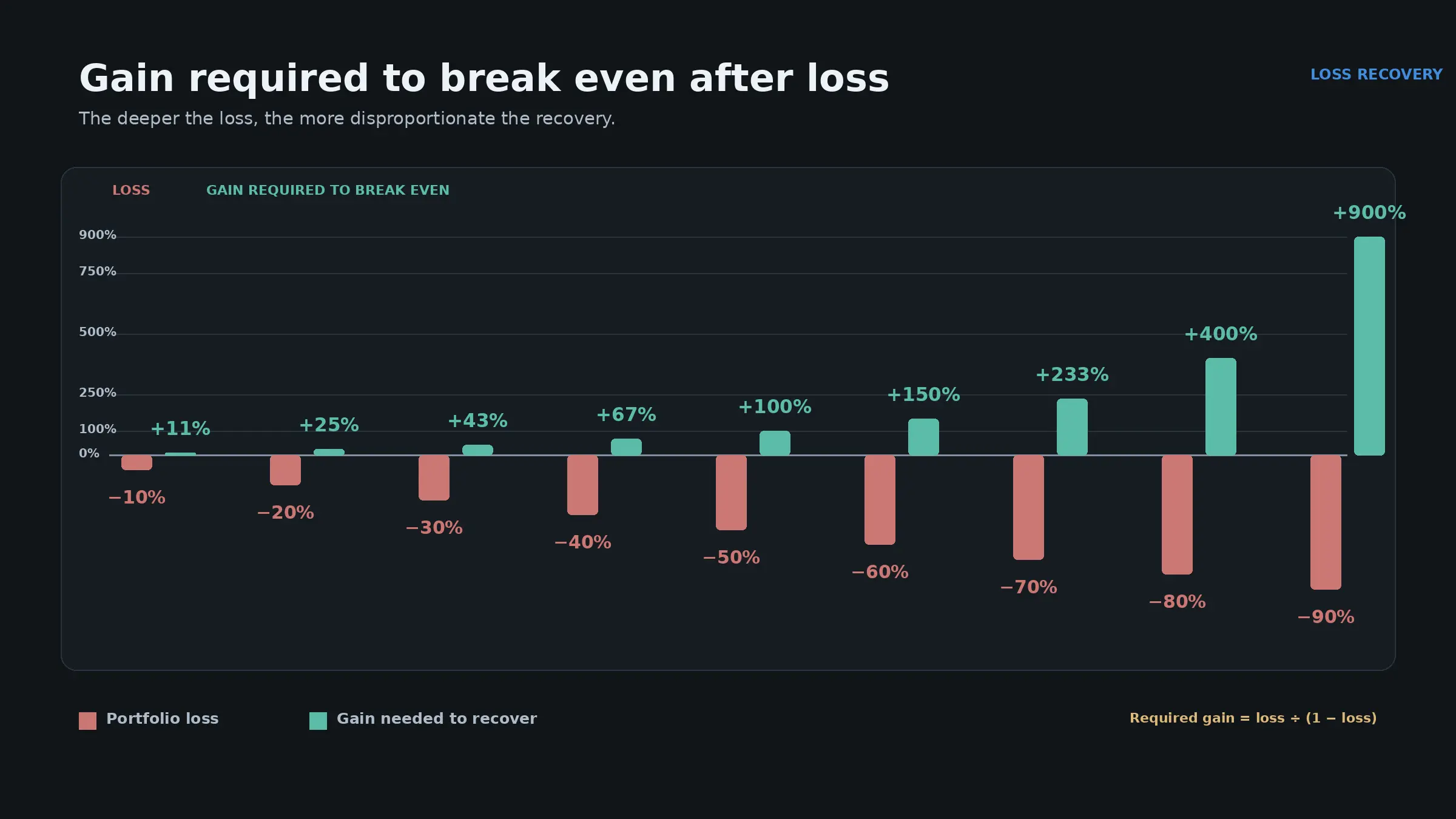
If you have $1000 in stocks a 50% correction leaves you with $500, a 50% recover would get you to $750. To break even from $500 you need a 100% gain.
That double has to come from a smaller base, in a portfolio that now has less capital working, while you are in the worst possible psychological state to make good decisions.
Takeaway
The cost of being wrong is convex, human confidence is not.Your maximum position size
Fat Pitches does not ask you to feel your way to a number. It computes two independent ceilings and takes the tighter:
weight = min( kelly ceiling , risk budget ÷ downside-to-floor )They are built on completely different foundations, and that is the point — each covers the other’s blind spot.
The risk budget ceiling
Rests on evidence. It asks: if this falls to its value floor, how much of my portfolio is permanently gone? A 3% budget on a name that can fall 30% to its floor caps it at 10%.
The Kelly ceiling
Rests on an estimated edge — which, for equities, carries an enormous standard error. Useful, but never to be taken literally. So it is shrunk hard before it is used.
Why the budget is a share of the portfolio, not the position
This is the detail that makes the rule actually work, and it is easy to get backwards.
The risk budget is expressed as a percentage of the whole portfolio, not of the individual position, because it has to aggregate. Ten names each risking 3% of the portfolio can impair 30% of it in a single correlated repricing — and a correlated repricing is precisely the event that tests every value floor at once. Floors do not fail independently. They failed in March 2020, together.
Size each position as though its floor is the only one that will ever be tested, and you have built a portfolio that is fine in every scenario except the one that matters.
Why Kelly gets shrunk
The Kelly criterion gives the mathematically growth-optimal bet size given a known edge. The trap is in “known”.
In a casino, the edge is a fact. In equities, it is your estimate, and your estimate has error bars you cannot see. Feed an overestimated edge into Kelly and it will confidently recommend a position that ruins you.
The literature on this is unusually clear about the shape of the penalty. Overbetting is punished asymmetrically: twice Kelly grows at zero, while half Kelly retains roughly 75% of the growth at a fraction of the variance. The cost of betting too small is a slightly slower compounding. The cost of betting too large is not slower compounding — it is termination.
So the sensible move is not to compute Kelly accurately. It is to compute it roughly and then —deliberately bet less—, scaled down further when the underlying business quality is weaker and the edge estimate therefore shakier.
A floor is a model, not a bound
Here is the honest caveat, and any tool that hides it from you is selling something.
A “value floor” is where the price could plausibly settle if you are wrong or the cycle turns. Fat Pitches computes several — net cash per share, book value, a stressed-earnings impairment using trough multiples, plus two explicitly labelled sentiment references like the 52-week low and the 200-day moving average, which are price references and not value at all.
Every one of them is a model:
- Net cash can turn out to be encumbered, trapped offshore, or already committed.
- Book value can be full of goodwill that is about to be written off.
- A trough multiple is the median of past cycles. It is a typical bad outcome, not a bound on bad outcomes.
Which is exactly why the app will not silently average them. If you have not pinned the floor you are committing to, it shows you how much the five disagree and asks you to choose. A single confident number that no human selected is worse than a visible disagreement.
And it is why position size is the real protection against ruin, rather than any of these numbers. The floor is an input to the sizing rule. It is not a safety net.
Takeaway
Modelled permanent loss is not guaranteed permanent loss. Size as if your floor might be wrong, because sometimes it will be.Concentration is still allowed
None of this is an argument for owning fifty names. Munger’s position on that was unambiguous:
“The wise ones bet heavily when the world offers them that opportunity. And the rest of the time, they don’t. It’s just that simple.”
— Charlie Munger
The rules above do not prevent a large position. They make a large position earn its size: it needs a genuinely small distance to a floor you have committed to, and business quality strong enough that the edge estimate is not fantasy.
What they prevent is the specific failure that ends portfolios — a big position that got big because it felt obvious. Which, as Marks has spent thirty years pointing out, is exactly the feeling that shows up at the top.
The word “heavily” in that quote is doing less work than people think. The load-bearing phrase is “and the rest of the time, they don’t.”
What about volatility?
Many times Buffett and Munger had been very clear about their view
We regard volatility as a measure of risk to be nuts — Warren Buffett, 2001
We ❤️ it. Provided we have not sized ourselves into having to sell.
A falling share price and a deteriorating business are different things. They can happen together, but one does not establish the other. Losing customers, exhausting cash or refinancing debt on punishing terms can damage what you own. A lower quotation tells you what someone will pay for it today. It deserves investigation, not an automatic verdict.
Think about owning a productive asset without a ticker, a rented house or a farm. You would still worry about its economics: what it earns, what maintaining it costs, and what could stop it earning. Giving that asset a continuously updated price does not replace those questions. Nor does a quiet price chart answer them. An overpriced business can look reassuringly stable right up until the assumptions supporting its valuation break.
For a buyer, price fluctuations - volatility, β (beta)- can widen the gap between what a business is worth and what it costs. If the evidence still supports your valuation, a lower price may offer a better purchase. But “it fell” is not an investment thesis, and “it will recover” is not a downside analysis. The opportunity depends on the business remaining sound—not on the chart having somewhere to bounce.
That is where sizing matters. You need the financial capacity to wait, not merely the conviction to say you will. Money needed soon, borrowing against your holdings, or a position large enough to provoke panic can make the market’s timetable more important than the business’s. A manageable position leaves you room to investigate, hold, or buy more within your limits. An oversized one can force a decision before the evidence does.
We do not size to eliminate movement in the account. We size to contain the consequences of being wrong—and to avoid turning an otherwise survivable price decline into a sale we cannot afford to postpone.
What this looks like in practice
In the app, step seven shows the two ceilings and which one binds. If you are on the free tier, with no broker connected, it is a planning figure only — expressed as a percentage of a planning capital number you set, and it never sizes a real order.
There is a deliberate separation there worth mentioning: the sizing used for planning and the sizing used on the real-order path are different code, and nothing in the planning module is permitted to reach a live order. That is a rule about blast radius, not a feature.
Before you set the size
- What is my floor, and did I choose it or did something average it for me?
- If this hits that floor, what percentage of my total portfolio is permanently gone?
- How many of my other positions would fall at the same time, for the same reason?
- Am I sizing this up because the analysis improved, or because the price moved?
Sizing is where the whole process either pays off or does not. Everything upstream — screening business risk, scoring quality, checking alignment, valuing the thing — exists to earn you the right to a confident number here. And it is last because it is the one decision that still works when the others failed.
The full seven-step walkthrough is in inside the Fat Pitches platform, and the risk distinction underneath all of it is in the two risks.
If somebody starts talking to you about β (beta), you know, zip up your pocketbook — Warren Buffett, 2001